
Canada Has an AI Strategy. Now Comes the Hard Part.
Canada has a national AI strategy.
After months of delay, Mark Carney and AI Minister Evan Solomon unveiled it in Toronto this morning. It’s called AI for All, and on the surface it has all the ingredients you’d expect: federal money, national ambition, and a lot of language about innovation, growth, trust, skills, adoption, and sovereignty.
But underneath the policy framing there’s a more interesting admission.
Canada has been very good at producing AI research. World-class institutions, globally respected researchers, a long history of contributing to the foundations of the modern field. What we’ve been less good at is turning that research into broad domestic adoption, durable Canadian companies, sovereign capability, and actual productivity gains across the economy.
That tension sits at the heart of the whole document. And it’s the part I actually care about, because I spend my days building in exactly this gap: deploying managed agents for clients, running Lorie Lowell’s daily agentic podcast pipeline and OpenClaw agent, and spending a genuinely unreasonable amount of time worrying about which cloud data touches and in what form. The strategy is, in a sense, a national-scale version of the same problem I keep running into at the level of a single droplet.
So the question isn’t whether the strategy reads well. Most strategies read well. The question is whether it becomes a real operating model for funding, procurement, training, and delivery, or whether it joins the long, distinguished pile of Canadian roadmaps that never quite make contact with implementation.
The headline: a multi-billion-dollar bet
The topline numbers are significant.
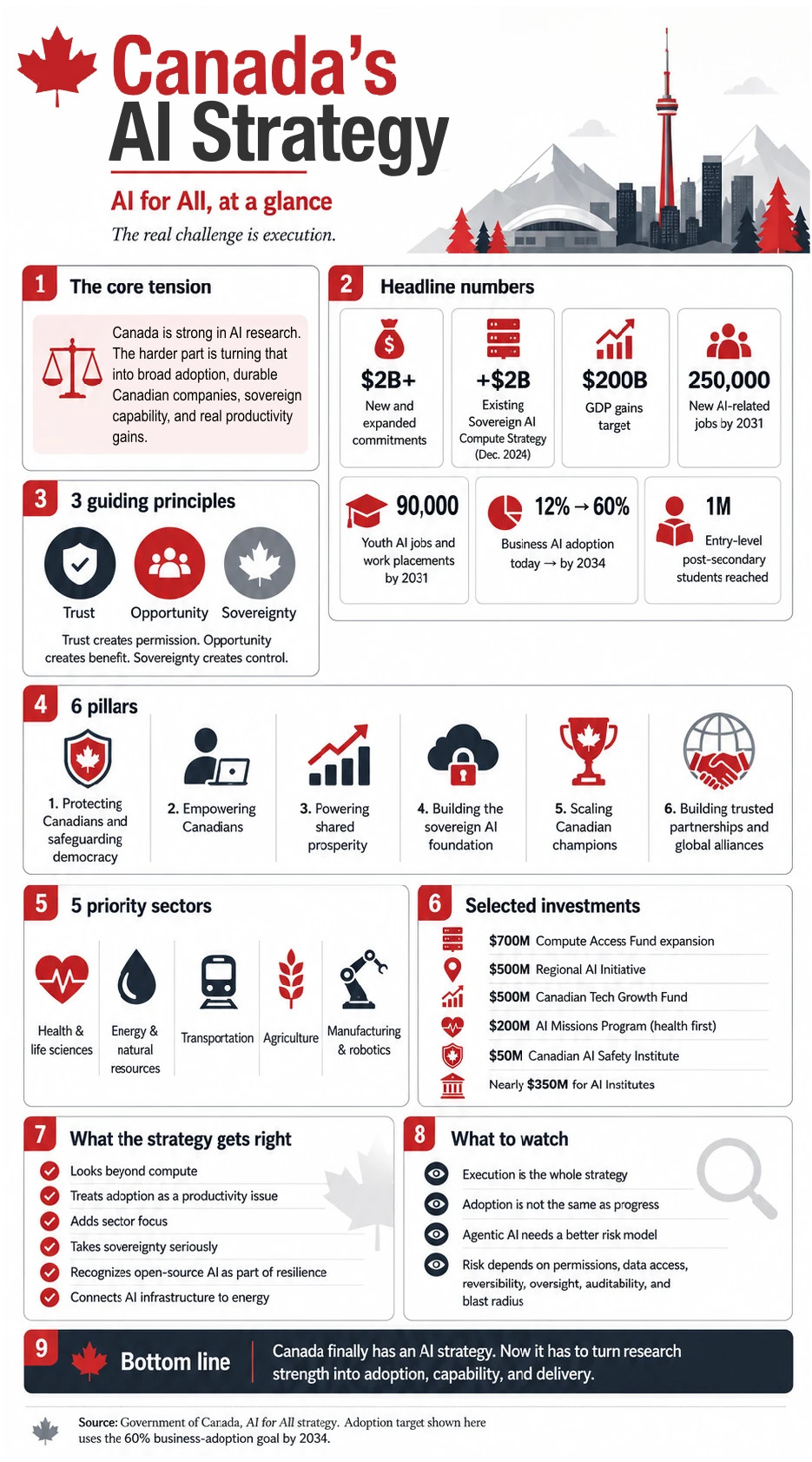
The strategy packages more than $2 billion in new and expanded commitments across adoption, compute access, safety, data infrastructure, and scale-up capital. This sits alongside the existing $2 billion Canadian Sovereign AI Compute Strategy from December 2024.
On targets, the government is aiming for $200 billion in additional economic growth and 250,000 new AI-related jobs over the next five years, plus up to 90,000 AI-related jobs and work placements aimed at young Canadians. The flagship adoption goal is to move business AI adoption from just over 12% today to 60% by 2034 (important note: the Prime Minister’s Office puts the target at 60% by 2034. The ISED strategy overview separately cites a rise from about 12% to 75% “with a focus on important industries”). There’s also a national literacy push aiming to reach 1 million entry-level post-secondary students, with free learning kits delivered through classrooms, workplaces, libraries, and community centres.
Ambitious. They also set up a clean test: can Canada move from AI potential to AI execution?
That’s the real story. Not whether the strategy document is compelling. Whether it leads to faster adoption, credible domestic infrastructure, literacy programs that aren’t just prompt-writing workshops, better public-sector capability, and a more grown-up public conversation about this technology.
What it gets right
A few parts of this are strong.
It recognizes the problem isn’t just compute. Compute matters. Infrastructure matters. Sovereignty matters. But the strategy doesn’t reduce the entire challenge to a GPU shortage. It puts real weight on literacy and skills, which is probably the bigger bottleneck for most Canadian organizations.
A lot of AI hesitation isn’t technical. People genuinely don’t know where these tools are useful, how to evaluate them, what risks matter, what’s safe, or how to tell capability from hype. That’s not an infrastructure problem. It’s a capability problem, and you can’t buy your way out of it with a data centre.
The literacy initiative leans into that: free training, delivery through libraries, workplaces, classrooms and community centres, learning kits, and, in Carney’s words, access to “trusted AI agents” for every post-secondary student, from the arts and commerce to STEM and medicine.
That phrase is either one of the most interesting commitments in the whole strategy or one of the vaguest. Trusted by whom? Hosted where? Logged how? Governed under what policy? With what model access, what privacy protections, what data retention, what evaluation, and what escalation path when the agent gives bad advice? That one sentence could hide an entire national architecture program.
Still, the basic point is right. If people can’t assess, use, question, and govern these systems, adoption either stalls or happens badly. Usually badly.
It treats adoption as a national productivity issue. The 12% to 60% target is one of the most important commitments in the document, because it’s an honest admission: Canada doesn’t have an AI research problem nearly as much as it has an AI adoption problem.
There’s a difference between having strong researchers, promising startups, and a healthy supply of press releases. And having thousands of organizations across the country actually using this stuff to operate better. Productivity isn’t a business-school abstraction. It shows up eventually in wages, services, competitiveness, healthcare delivery, and whether our institutions can keep pace. We are currently not keeping pace. Carney was blunt about it on stage, noting Canada ranks near the bottom of countries on AI training, literacy, and trust, and that only 12% of Canadian businesses use AI today, lower still among small and medium-sized firms.
The adoption pillar brings the right levers: an AI readiness assessment tool for SMEs, SME access to public compute, government as a strategic anchor customer, accelerated procurement, and a fellowship program to build internal government expertise. The levers are right. Whether they get pulled well is the entire ballgame.
It puts some sector focus behind the ambition. This is important, because “AI everywhere” usually becomes “AI nowhere in particular.” The strategy names priority sectors: health and life sciences, energy and natural resources, transportation, agriculture, and manufacturing and robotics. It also calls out dual-use applications that line up with defence, sovereignty, and security objectives.
That kind of focus matters. It turns AI adoption from a perfectly horizontal spreadsheet exercise into something closer to an industrial strategy. Canada has real assets in these sectors: public health systems, natural resources, agriculture, transportation corridors, advanced manufacturing, robotics, research institutions, and a lot of painful operational friction. If AI is going to produce actual national value, it probably shows up first in places like this, not in another generic office chatbot pilot.
It puts sovereignty on the table seriously. Canada is openly worried about dependence on foreign-owned AI infrastructure, and Carney made the case directly: Canada is highly dependent on foreign suppliers across compute, cloud, and data storage, which creates real risk that foreign entities could access Canadian data, and that AI could eventually be weaponized against us the way other forms of integration have been. When Amazon, Microsoft, and Google reportedly hold something like 85% of Canada’s public cloud market, “we’ll just rent it” stops being a neutral position.
The sovereign pillar points at a world-leading public AI supercomputer slated for 2031, secure compute facilities, a national data platform, and the part I find genuinely smart: the new AI Missions Program, whose flagship health mission deploys $200 million to push AI into diagnostics, patient care, and system efficiency. The platform underneath it is VITAL, which uses federated analytics to run on provincial health datasets one at a time without the data ever leaving its jurisdiction. That’s sovereignty expressed as an actual architecture decision instead of a slogan, which is the only version of sovereignty that means anything. The word goes vague fast when it isn’t tied to specific design choices.
There is another sovereignty thread in the document that should not get lost under the GPU-and-cloud conversation: Indigenous leadership and data governance. The strategy talks about Indigenous communities shaping AI development, Indigenous data standards, language models, land-management tools, and cultural heritage systems. That matters because sovereignty is not only a federal cloud procurement problem. It is also about who gets agency over the data, language, knowledge, and systems that represent them.
This is where I stop nodding along to the abstract version. Carney made a point of saying Canada is one of only four countries in the world with its own large language model. True (see Cohere), and Cohere is a real asset, but for most of what I build day to day, the capable model is still a US-hosted one, and pretending otherwise helps no one. Sovereignty isn’t binary, and the strategy is right to treat it as a spectrum of design choices rather than a flag you plant. For the managed agents I run for clients, I’m pulling two levers, and neither one requires Canada to build a competitor to the big labs first.
The first is data residency: the agents land on Canadian-region infrastructure, so their state, logs, and orchestration stay in-country. That helps, but it’s only half the story, because a Toronto-region droplet on a US-domiciled provider still sits inside US legal reach. Residency is not the same as immunity, and anyone who spent time in Canadian payments knows the difference matters.
The second lever is the one I find more interesting, and it’s why I open sourced privox: a Rust proxy that sits at the inference-call boundary, the exact place I argued the real data-exposure decision happens. The prompts those agents generate still go out to US-hosted frontier models, because that’s where the capability is. But before a prompt crosses the boundary, privox tokenizes the PII out of it. Names, account numbers, and health identifiers get swapped for opaque tokens; the model sees only the tokens; the response gets de-tokenized on the way back. The sensitive data never exists in plaintext on anyone else’s infrastructure. That’s a concrete, buildable answer to the sovereignty question: you keep the data sovereign even when the model isn’t.
That’s the level at which I wish the strategy talked about sovereignty. Not domestic compute as a category, but the specific architectural seams: data residency, boundary controls, what crosses the border and in what form, where a Canadian organization actually has leverage today, without waiting a decade for a public supercomputer to come online.
It recognizes open-source AI as part of resilience. This is easy to miss, but important. The strategy calls out open-source AI as a way to reduce lock-in, improve transparency, lower costs, support local adaptation, and enable on-prem or privacy-sensitive deployments. That fits the sovereignty theme better than almost anything else in the document.
Sovereignty is not one giant national model. It is a stack of choices: open tools, local deployment, portable interfaces, inspectable systems, data controls, and fewer irreversible dependencies. Open source is not magic, and it does not remove the need for governance, evaluation, security, or responsible deployment. But it does give Canadian institutions and companies more room to adapt, inspect, and operate systems on their own terms.
It connects AI infrastructure to energy. Compute strategy is also energy strategy. The document is clear that Canada’s clean, relatively predictable electricity grid is an advantage, but that available power is also a constraint. That’s a useful reality check. You don’t get sovereign AI infrastructure by announcing data centres. You need power, cooling, fibre, procurement demand, permitting, capital, and customers.
This matters because Canada does have a plausible advantage here. Clean energy, cold climate, land, fibre routes, research strength, and political interest can become something real. But only if energy planning, compute planning, and industrial planning actually talk to each other. A GPU cluster without power is a PowerPoint slide with fans.
Three principles, six pillars
Carney framed the strategy around three guiding principles, during today’s press conference: trust, opportunity, and sovereignty. Trust means protecting Canadians, their data, their privacy, and their children. Opportunity means giving workers, students, businesses, and public institutions the tools and skills to benefit from AI. Sovereignty means ensuring Canadians have real choice and control over how AI is built, governed, hosted, and managed.
The sequencing is important too: trust creates permission, opportunity creates benefit, and sovereignty creates control.
The written strategy then turns those principles into six pillars. That distinction is useful. The three principles are the political frame. The six pillars are closer to the operating model.
1. Protecting Canadians and safeguarding democracy (trust). Safety, governance, online harms, the expanded Canadian AI Safety Institute, plus promised legislation: modernized privacy and online-safety laws, consumer privacy rules to protect children’s data, and new protections against deepfakes and surveillance pricing. This one matters because public trust is the ceiling on how much room AI gets to operate in Canadian society, and right now that ceiling is low. Canadians are among the least enthusiastic populations in the world about AI; the strategy itself leans on the fact that a large share of us see it as a threat. If people experience AI as opaque, extractive, or imposed without accountability, the backlash will be entirely predictable and entirely deserved.
2. Empowering Canadians (opportunity). This is the literacy and skills pillar, and one of the strongest parts. Literacy can’t just mean teaching people to write prompts. It means understanding what these systems can and can’t do, how they fail, where they help, how they touch privacy and work, and when human judgment is still the thing that matters. That’s for students, workers, educators, public servants, parents, and managers, not a specialist audience.
3. Powering AI adoption for shared prosperity (opportunity). The adoption pillar: theory to impact. The point isn’t to bolt AI onto everything. It’s a deliberate adoption path: used where it creates value, with risks understood, and with organizations building the internal capability to use it responsibly instead of buying a chatbot and declaring victory. This is also home to the SME-facing money: the BDC LIFT program for financing, $500 million to a regional AI initiative for adoption and commercialization, and the $700 million expansion of the Compute Access Fund, plus the AI Missions Program that tries to drag research out of the lab and onto real problems.
4. Building the sovereign AI foundation (sovereignty). Domestic compute, the public supercomputer, the national data platform, open-source AI, and energy infrastructure. Carney also confirmed he’s directed the federal Major Projects Office to develop sovereign cloud capacity, and framed procurement around a build, partner, buy hierarchy borrowed from the defence industrial strategy: build in Canada first, partner with allies where you can’t, buy from abroad only after exhausting both. That ordering is the right instinct. The question, as always, is whether procurement actually follows it.
5. Scaling Canadian champions (sovereignty). Capital and scale-up support, headlined by the new $500 million Canadian Tech Growth Fund, which will take equity stakes in high-potential Canadian AI firms, plus nearly $350 million to expand the AI institutes in Montreal, Toronto, and Edmonton. The deeper question isn’t whether individual companies win. It’s whether Canada retains the talent, IP, headquarters, and decision-making capacity as AI gets more economically important. We have watched the commercial upside of our own research walk south of the border before.
6. Building trusted partnerships and global alliances (trust). Ottawa files this one under trust, which makes sense at the values-and-allies level. But the logic also runs straight through sovereignty. Canada is trying to reduce dependence on any single country or platform by building a network of trusted partners, shared infrastructure, research collaboration, talent flows, and aligned procurement. Sovereignty does not mean isolation. Nobody is building the whole AI stack alone. The realistic goal is resilience through domestic capacity plus trusted partnerships.
Where it needs more work
The strategy is strongest at the level of direction. It’s weaker exactly where strategies are always weaker: implementation.
Agentic systems need a better risk model
Here’s the part I keep waiting for governments to get right, and mostly they don’t.
A lot of AI governance still treats autonomy as a single slider: more autonomous, more dangerous; less autonomous, safer. In practice, especially with agents, risk is multi-dimensional. I made this argument back in March when I wrote about agent identity, and it’s only gotten more relevant since.
A system’s risk isn’t just how autonomous it is. It’s permissions, data access, reversibility, human oversight, auditability, operational blast radius, system integration, and whether the thing is merely advising a human or actually taking consequential action in the world. A highly autonomous agent can be low-risk if it runs in a sandbox with reversible actions and no real permissions. A barely-autonomous one can be genuinely dangerous if it’s wired into production systems, customer communications, financial workflows, or regulated decisions. I run both kinds. The autonomy dial tells you almost nothing about which is which.
This is not a pedantic distinction. It’s the difference between a useful procurement framework and a useless one. Singapore already figured this out. Their Model AI Governance Framework for agentic AI uses a graduated, multi-tier autonomy taxonomy with governance scaling at each level. Canada’s strategy gestures at the right ideas through trust, safety, and impact measurement, but it would be much stronger with an explicit, multi-dimensional model for agentic risk.
To be fair, the strategy does point at pieces of the control plane: model evaluation, transparency, watermarking, standards, certification, incident monitoring, and an expanded Canadian AI Safety Institute. That’s useful. But for agentic systems, the missing layer is still the practical risk model: permissions, data access, reversibility, human oversight, blast radius, auditability, and egress controls.
This is also the layer where the actual controls live, and almost no policy document describes them. The agents I run for clients sit behind Cloudflare Access for zero-trust auth, and increasingly behind privox on the way out, so “what can this agent do” is answered by its permissions and what it’s allowed to send across the boundary, not by an abstract autonomy score. Lorie is fully autonomous in the sense that she publishes a podcast every day with no human in the loop, and almost entirely low-risk, because her blast radius is an RSS feed and a couple of social accounts. A semi-autonomous agent wired into a client’s CRM with live customer records is a completely different animal, even though it’s less autonomous on paper. The dial doesn’t capture that. Permissions, data access, and egress controls do.
Get this wrong and you fail in both directions at once: organizations avoid useful systems that merely look autonomous, while deploying genuinely risky ones because the autonomy label seemed modest.
Execution is the whole strategy
The direction is clear. The hard part is everything after the press conference.
Canada is not short on strategies, frameworks, consultations, roadmaps, or advisory bodies. We are world-class at producing those. The test here is whether this one produces visible improvements in public capability, private-sector adoption, domestic infrastructure, literacy, and trust.
Procurement matters, because government can’t credibly preach AI adoption while being unable to adopt it well itself. Literacy matters, because people can’t consent to, challenge, or benefit from systems they don’t understand. Sovereign infrastructure matters, because dependency stays invisible right up until the moment it becomes expensive, risky, or politically constrained, usually at the worst possible time.
The Prime Minister’s Innovation Fellows Program is one of the more interesting execution mechanisms because it acknowledges that government does not just need AI vendors; it needs internal technical muscle. Procurement without in-house judgment is how institutions buy impressive demos and discover six months later that nobody knows how to evaluate, operate, or govern them.
The strategy also says it will remain dynamic because AI is moving faster than any single strategy can anticipate. Good. That means it should probably be judged less like a fixed roadmap and more like a national product operating model. Does it learn? Does it ship? Does it measure? Does it update when reality changes?
The execution question isn’t a question. It’s the strategy.
What this could mean for Canadians
If it works, the wins show up in a few places. Public services that are easier to navigate and less buried in manual process. Health and life sciences benefiting from better research infrastructure and clinical data systems. The AI Missions health mission and the VITAL platform are real attempts at this rather than hypotheticals, aimed at things like ER wait times, primary-care access, and the administrative load on clinicians. Energy systems better able to manage demand. Farms using AI to improve yields and reduce inputs. Transportation systems that adapt to congestion instead of merely measuring it. Manufacturers and robotics companies building capability here instead of simply importing it.
Carney reached for concrete examples on stage: infant heart-condition screening, fertilizer optimization on farms, adaptive traffic lights cutting congestion and emissions. Those are exactly the right kind of example. Workers getting actual access to upskilling instead of being told to figure it out alone. Students graduating into a market where AI fluency is normal. Indigenous communities having a real say in how AI affects their data, languages, culture, land, and services. Institutions less dependent on foreign infrastructure for things that matter.
None of that is automatic.
Done badly, AI makes services colder, less accountable, and more frustrating. It intensifies surveillance, weakens privacy, concentrates power, and invents new forms of exclusion. It becomes a layer of automation bolted on top of a broken process instead of an excuse to fix the process. That’s the failure mode, and it’s the default failure mode unless someone is actively steering away from it.
Which is exactly why the language around trust, literacy, and governance matters, and why those commitments have to survive contact with implementation. The goal was never more AI everywhere. The goal is better systems, better services, better decisions, stronger institutions, and a public that can actually understand and shape the technology landing on top of them.
Adoption is not the same as progress
That 12%-to-60% number is going to be the most-quoted figure from this whole thing. It’s useful. It should also be handled carefully.
An organization can adopt AI in the shallowest possible way: buy some tools, run a pilot, staple a chatbot to an existing workflow, and declare transformation. That counts statistically while improving nothing. I’ve watched it happen. The metric goes up; the work gets no better.
The real question is whether adoption produces value: better quality, accessibility, safety, responsiveness, or efficiency in the systems it touches. Whether it helps people do better work, cuts genuine administrative drag, preserves privacy and accountability, and builds Canadian capacity instead of just deepening our dependency on someone else’s platform.
Canada should not be aiming to become a country where everyone uses AI badly. It should be aiming to become a country where AI is used thoughtfully, safely, and effectively. Those are very different targets, and only one of them shows up in an adoption percentage.
Final thought
Canada can’t coast on past AI credibility. It is not enough to point at research leadership while lagging on adoption, commercialization, infrastructure, and basic societal readiness.
This strategy is, in part, an admission of that gap. That’s a genuinely useful place to start, more useful than the triumphant version would have been.
Now the work is execution. And I’ll be honest: that’s the part we’ve historically been worst at. I hope this time is different. I’m building as though it will be either way.
P.S. Most of this isn’t theoretical for me. Agentic North Labs is building in exactly this gap: managed agents on Canadian-region infra, privox to keep PII out of foreign cloud at the inference boundary, and a no-signup Canadian-hosted inference endpoint I’ve been designing for the day “just send it to a US API” stops being an acceptable answer. If the strategy means sovereignty as something you build rather than something you announce, that’s the seam it has to reach. It’s the seam I’m already working in.