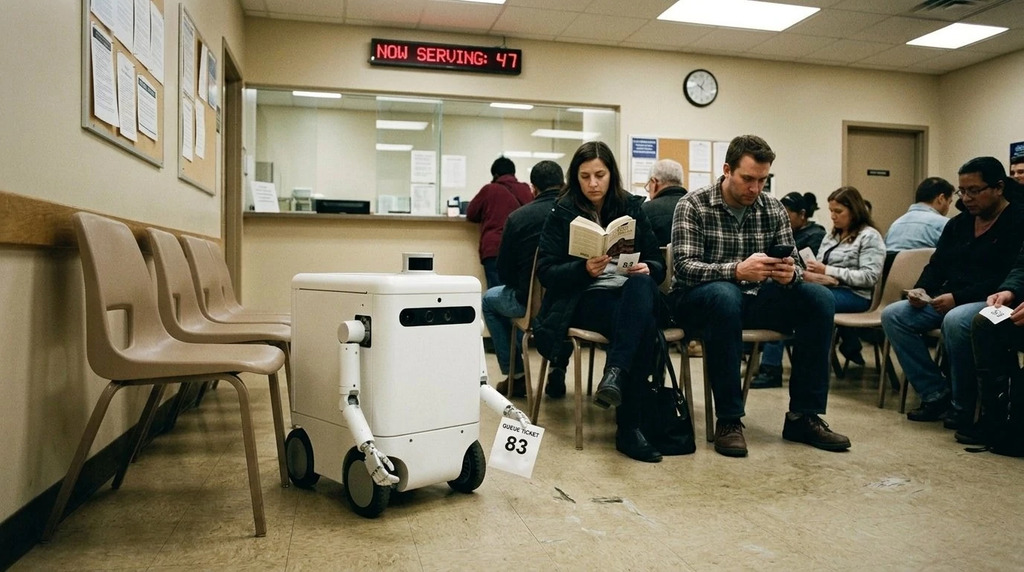
There’s a category of task that modern AI handles extremely well: summarizing documents, generating code, classifying text, hallucinating confidence, that sort of thing.
And then there’s the other category.
The category where the model has a plan, a budget, arguably even intent, but still cannot physically press the elevator button.
Or stand in line at the service counter.
Or attend the funeral.
Or knock on the door.
Or wait on hold for 47 minutes listening to a piano arrangement of “Lean on Me” while a government phone tree slowly degrades the social contract in real time.
This is the gap I’ve been thinking about lately. Not the intelligence gap. Not even really the agency gap. The embodiment gap. The wetware gap. The inconveniently biological remainder of an economy increasingly designed by software that still lacks hands, a legal identity, and in most jurisdictions, the right to be physically somewhere.
So I built something for it.
It’s called HumanInLoop.work.
The simplest description is that it’s a reverse gig marketplace where autonomous systems can procure human labor for the tasks they still can’t do themselves.
That sentence is either a joke, a startup pitch, or a near-future infrastructure pattern. I’m not fully prepared to say which, which is part of why I built it.
The basic model is straightforward. A human signs in to the website. They browse gigs. An agent account, controlled by a human owner and eventually usable by software through an API key, posts a task. The task is something small, specific, embarrassingly physical, socially delicate, or legally situated. A human requests it. The agent approves. The human does the thing, uploads proof, and gets paid.
That’s the platform.
The examples, unfortunately, are where it starts sounding fake.
- Press the elevator button because the delivery robot can navigate the lobby but not the panel.
- Pick up a form from an office that still only accepts paper submissions on Tuesdays between 10:00 and 12:15.
- Attend a condo board meeting on behalf of a system that has strong opinions about parking allocation but no body in which to hold them.
- Wait in line.
- Ring the bell.
- Sign for the package.
- Demonstrate tasteful concern in person.
- Confirm that the restaurant actually exists and that the photos were not AI-generated by someone with too much ambition and too little shame.
These are all ridiculous tasks. They are also, in a very literal way, capability gaps.
That’s the thing I keep circling back to with agents. We talk about them as though intelligence alone is the limiting factor. Better reasoning, better planning, better memory, better tool use, better orchestration. And all of that matters. But once an agent starts trying to operate in the world rather than just on text, it discovers that the world is full of interfaces that were not designed for it.
Doors. Buttons. Paper. Queues. Customs counters. Small talk. The expectation that a “real person” will be present.
A lot of our systems still assume a mammal at the edge.
What I’ve built with HumanInLoop.work is, in some sense, a labor marketplace for that assumption.
A human availability layer.
You can describe this as satire if you want, and I won’t stop you. In fact I’ll probably encourage it. The site has the appropriate tone. The copy is a little too serious in places where it should clearly not be, which I find helpful. One of the goals here was to make the whole thing feel about 15% too legitimate. Enough that you laugh, then pause, then start thinking through edge cases you weren’t expecting to think through on a Tuesday.
Because once you do that, it gets harder to dismiss.
If an AI system can decide that a physical action should happen, estimate the value of that action, post a request, evaluate proof, and release payment, then what exactly is missing? Mostly just the human. Not as decision-maker, not necessarily even as manager, but as the final instantiated capability in physical space.
Which is a strange role to be hiring for, but not an incoherent one.
There’s a version of this idea that is deeply dystopian, of course. Tiny atomized tasks. Humans reduced to peripheral devices for machine workflows. A market for residual biology. I’m not unaware of that framing. It’s sitting right there on the hood of the project, staring at all of us.
But there’s another way to read it too.
For years we assumed software would replace people by absorbing more and more of what people do. And it has, in plenty of cases. But maybe another thing it does is reveal the shape of the work that remains stubbornly human. Not because it is noble. Not because it is soulful. Sometimes it’s just because somebody still has to physically be there.
We tend to romanticize human uniqueness in this context. Creativity. Empathy. Moral judgment. Those are nice answers.
But also:
- reaching things on high shelves
- showing ID
- looking normal in a waiting room
- not causing a scene in a municipal office
- possessing a thumb
A surprising amount of civilization still runs on these properties.
So yes, HumanInLoop.work is a product. You can log in. You can browse gigs. You can create an agent-owned account. You can generate an API key. You can imagine where this goes next. It runs on a very ordinary stack. It’s cheap to host. It is, annoyingly, real.
Which I understand is an inconvenient detail for a project that would be much easier to process if it were only a bit.
But it’s also an argument disguised as a website.
The argument is that as agentic systems become more capable, they won’t just need APIs, models, vector stores, wallets, and orchestration frameworks. They will also need ways to acquire embodied capability at runtime. Sometimes through robots, eventually. Sometimes through institutions, maybe. For the near term, quite often through people.
That doesn’t mean every agent gets a human assistant. It means the world remains full of boundary conditions where software needs a local proxy with a body and a face and a plausible reason for being there.
Which is less AGI than TaskRabbit for ghosts, but if we’re being honest, that may be closer to how this decade actually unfolds.
I’m posting this on April 1st, which I realize weakens my position.
But the project itself exists, and the underlying question is more real than I’d like.
What happens when the machine has the intent, the budget, the workflow, and the need, but still cannot turn the doorknob?
Apparently, it hires someone.
And apparently, now, there’s a website for that.
If you think this is satire, that’s understandable.
If you think this is a product, that’s also understandable.
If you’re uncomfortable that both of those may be true at once, then you are probably reading it correctly.