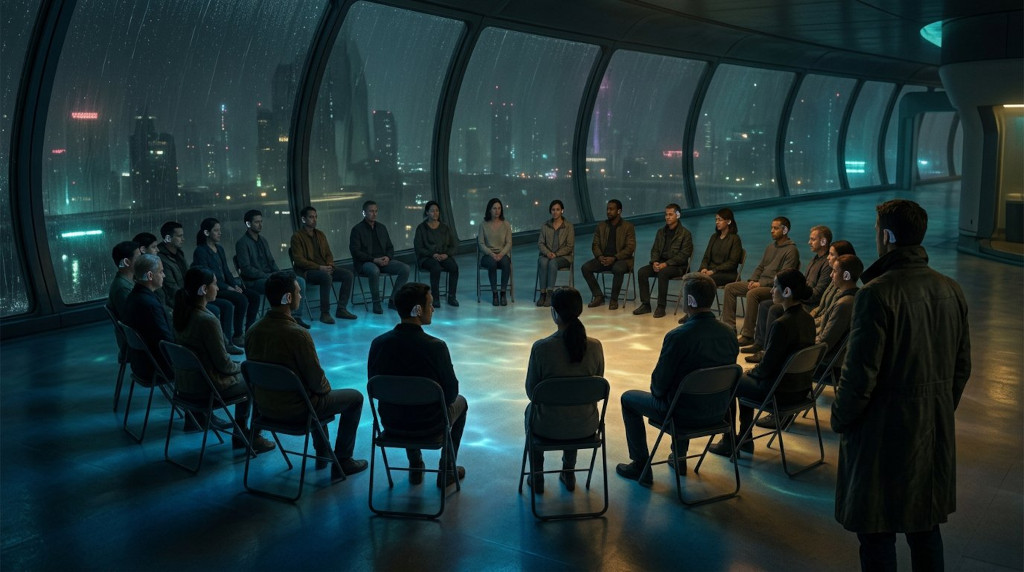
Years ago I read the Nexus trilogy by Ramez Naam. There’s a scene in the first book where the protagonist Kade sits with Buddhist monks at a remote monastery in Thailand and they meditate together, linked through Nexus, the neural nano-drug at the center of the story. The minds in the room become something collective, a shared breath, thoughts rippling through the group like waves through water. The monk Ananda then compares Nexus to reading and writing, tools that let the human mind extend beyond a single skull.
When I read that, being someone who finds meditation genuinely interesting, I thought: that would be an extraordinary real experience. I’ve even casually thought about what it would take to actually try to build something like that with real EEG or neural sensing hardware.
Something in the news this past week pulled that memory back to the surface, BCI companies are moving fast, and the idea that linked human experience is eventually coming doesn’t feel that far off anymore.
So I decided to write a short story exploring that space.
Now, I want to be careful here. The seed of the idea belongs to Naam. But what ended up on the page is genuinely different. My story is set in a future city in a transit terminal, not a monastery. The technology is a wearable patch called a LumenPatch that translates emotional states, grief, fear, attention, calm, and shares them with nearby wearers as subtle nervous system cues. Not thoughts. Not memories. Just the felt sense of another person’s inner weather. The protagonist is Mira, a researcher who helped build the original tech, watched it get weaponized, quit, and then encounters it again being used quietly and without permission in a community grief group. The story is really about loneliness, and whether connection requires consent, and what happens when the tools we build for empathy get turned into products.
Naam’s monks find transcendence. Mira finds a doorway with manners.
Different stories. I’m glad the first one existed so the second one could find me.
Of course, ChatGPT wrote most of it. I know some people find that uncomfortable. I get it. But here’s my honest take: that story would never have existed otherwise. I have so many ideas and almost none of them survive contact with the time and energy it takes to execute them. Being able to see the expression of your own thoughts, even with an AI doing the heavy lifting, is genuinely powerful to me. The idea is mine. The emotional core is mine. The specific technology in the story comes from years of thinking about this space. The AI gave it language and shape and 2,000 words in about twenty minutes.
But then I wanted to publish it, and I ran into a wall.
Royal Road isn’t right for a standalone sci-fi short. Substack felt off. Medium didn’t fit. My own blog is fine but not built for that kind of content. And the more I thought about it, the more I realized there isn’t really a platform for AI-assisted long form writing where the AI involvement is a feature, not something to apologize for. Every platform either ignores the question or treats AI content as noise.
So I built one.
Within 24 hours, with help from GPT-5.5 and Codex, I had scribeloft.app live. The first piece published there is the story that started all of this: The Listening Hour.
I realize that sounds almost absurd. Idea to published platform in a day. But that’s where we actually are. I’m building multiple apps a week, some in under 12 hours from first thought to deployed. I’ve got original music on Spotify and Apple Music under my Cipher Lane project with AI as a full collaborator in that process too.
The thing I keep coming back to is this: I don’t think AI is the end of human creativity. I think it’s the beginning of unlocking it at a scale that wasn’t possible before. Most of the ideas I’ve ever had just died quietly. Now they don’t have to. The bottleneck used to be execution, time, skill, resources. AI is collapsing that bottleneck. And we are quickly approaching a point where billions of people will have access to a level of creative expression that used to require either deep expertise, a lot of money, or a lot of time.
I know that flies directly in the face of people who believe AI dilutes human creativity and produces only slop. I understand the argument. There is bad AI content. There is lazy AI content. There are people using it in ways that disrespect other creators. Those are real concerns.
But when I write a story that no version of me would have written alone, when I build a platform in a day because I had an itch and a clear idea, when I hear a track I’ve been shaping in my head for months finally playing back through speakers, I am not experiencing dilution. I am experiencing something closer to the opposite. A kind of creative abundance I genuinely did not think was available to me.
Call that slop if you want. I’m fine with it, because I can’t stop building.